
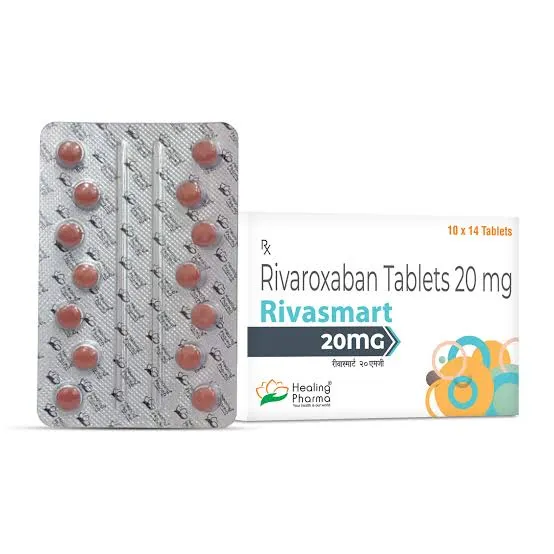
Rivasmart (Rivaroxaban) 20mg Tablets
What is Rivaroxaban 20mg?
Rivaroxaban 20mg is a first-in-class, once-daily oral anticoagulant — a blood-thinning medicine that prevents dangerous blood clots from forming and growing inside your blood vessels. It belongs to a revolutionary class of medicines called DOACs (Direct Oral Anticoagulants) or NOACs (Novel Oral Anticoagulants) — specifically a Factor Xa inhibitor — and represents a major advance over older blood thinners like Warfarin.
Rivaroxaban was the first orally dosed, direct Factor Xa inhibitor — a small-molecule oxazolidinone derivative. Since its approval, it has transformed the management of blood clot disorders and stroke prevention — offering patients predictable, effective anticoagulation without the need for frequent blood monitoring (INR tests) that Warfarin requires.
The 20mg dose is the primary therapeutic and maintenance strength of Rivaroxaban — used across its most important clinical indications including atrial fibrillation stroke prevention and the ongoing treatment of deep vein thrombosis (DVT) and pulmonary embolism (PE) after the initial treatment phase.
What is Rivaroxaban 20mg Used For?
Approved Medical Indications:
- Atrial Fibrillation — Stroke Prevention — Rivaroxaban is used to prevent stroke and blood clots in patients with certain heart rhythm problems such as nonvalvular atrial fibrillation. In atrial fibrillation, the heart's upper chambers beat chaotically and irregularly, allowing blood to pool and form clots — clots that can travel to the brain and cause a devastating stroke. For reduction of the risk of stroke and systemic embolism in patients with nonvalvular atrial fibrillation, the recommended adult dosage of Rivaroxaban is 20mg once daily with the evening meal.
- Treatment of Deep Vein Thrombosis (DVT) — Rivaroxaban is used to treat deep venous thrombosis (DVT), a condition in which harmful blood clots form in the blood vessels of the legs. After the initial 21-day treatment phase at 15mg twice daily, your doctor may give you 20mg once a day, taken at the same time each day with food.
- Treatment of Pulmonary Embolism (PE) — These blood clots can travel to the lungs and can become lodged in the blood vessels of the lungs, causing a condition called pulmonary embolism (PE). Rivaroxaban 20mg is used to treat this serious, life-threatening condition following the initial intensified dosing phase.
- Prevention of Recurrent DVT and PE — Rivaroxaban also reduces the risk of blood clots occurring again in patients who are still at risk for DVT or PE after receiving treatment for at least 6 months. The 20mg once-daily dose is the standard maintenance dose for ongoing secondary prevention.
- Post-Hip or Knee Replacement Surgery — This medicine is used for several days after hip or knee replacement surgery while you are unable to walk — it is during this time that blood clots are most likely to form. Rivaroxaban prevents potentially fatal post-surgical clots during the highest-risk immobility period.
- Coronary Artery Disease (CAD) & Peripheral Artery Disease (PAD) — Rivaroxaban is indicated, in combination with aspirin, to reduce the risk of major cardiovascular events (cardiovascular death, myocardial infarction, and stroke) in patients with chronic coronary artery disease, and to reduce the risk of major thrombotic vascular events in patients with peripheral artery disease. Note: for CAD/PAD indications, the dose used is 2.5mg twice daily — not the 20mg strength.
How to Take Rivaroxaban 20mg
For Atrial Fibrillation (Stroke Prevention):
- Take 15mg or 20mg once a day, taken with the evening meal.
- The evening meal is essential — food significantly increases Rivaroxaban's absorption and ensures consistent blood levels throughout the night, when stroke risk in atrial fibrillation is particularly high.
- Reduce dosage to 15mg once daily in patients with reduced kidney function (creatinine clearance ≤50 mL/minute).
For DVT/PE Treatment (Maintenance Phase):
- After completing the initial 21-day phase of 15mg twice daily with food, switch to 20mg once daily with food for the remaining treatment duration.
- If you have had a blood clot (DVT or pulmonary embolism), you'll usually take Rivaroxaban for at least 3 months. Depending on what caused the blood clot, you might need to take it for longer.
For Prevention of Recurrent DVT/PE:
- After at least 6 months of standard anticoagulant therapy, 20mg once daily is used for ongoing secondary prevention.
General Instructions:
- Always take the 20mg tablet WITH food — this is critical for this strength. Food increases absorption by up to 39% compared to the fasted state, ensuring therapeutic blood levels are reached and maintained.
- Take at the same time each day — consistency is key to maintaining steady anticoagulant protection.
- Swallow the tablet whole with a full glass of water.
- If you have a heart problem like atrial fibrillation or have had a heart attack, you might need to take Rivaroxaban long term or even for the rest of your life. Do not stop taking Rivaroxaban without talking to your doctor.
- Never stop Rivaroxaban suddenly — premature discontinuation of any oral anticoagulant, including Rivaroxaban, increases the risk of thrombotic events. Always consult your doctor before stopping or adjusting your dose.
- If you miss a dose, take it as soon as you remember the same day. If it is close to your next dose, skip the missed dose and continue as normal — never double dose.
Common Side Effects
The most clinically significant side effect of Rivaroxaban — as with all anticoagulants — is bleeding. Rivaroxaban can cause you to bleed more easily, even from a minor injury.
Signs of bleeding that require prompt medical attention: Call your doctor if you have signs of bleeding such as bruising or bleeding that will not stop (nosebleeds, bleeding gums, heavy menstrual bleeding); pain, swelling, new drainage, or excessive bleeding from a wound; headaches, dizziness, weakness, feeling like you might pass out.
Other reported side effects include:
- Nausea or mild stomach discomfort — taking the tablet with food significantly reduces this
- Mild dizziness or lightheadedness
- Skin rash or itching — rarely
Important Warnings & Contraindications
Pregnancy: Taking Rivaroxaban during pregnancy may cause bleeding in the mother or the unborn baby. Tell your doctor if you are pregnant or plan to become pregnant.
Breastfeeding: It may not be safe to breastfeed a baby while you are using Rivaroxaban. Ask your doctor about the risks.
Prosthetic Heart Valves: Rivaroxaban is not recommended for patients with prosthetic heart valves or rheumatic heart disease, and should be avoided in patients with mechanical valves or moderate-to-severe mitral stenosis.
Active Bleeding: Active pathological bleeding is an absolute contraindication for Rivaroxaban use.
Liver Disease: Significant liver impairment associated with coagulopathy contraindicates Rivaroxaban use.
Alcohol: This medication may cause stomach bleeding. Daily use of alcohol while using this medicine will increase your risk for stomach bleeding. Limit alcoholic beverages.
Prescription Required
Rivaroxaban 20mg is a prescription-only medicine. Please upload a valid prescription or consult your doctor before purchasing. Our licensed pharmacists are available to answer any questions about your anticoagulation treatment and to ensure your medicine is dispensed safely.